What does a Managed Print Services provider actually take over?
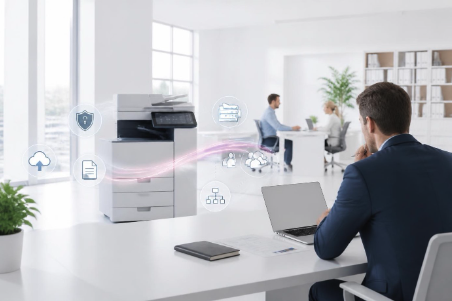
Did you know that Managed Print Services goes far beyond managing printers and supplying paper and toner? The scope of these services may extend further than you might initially think. At OneXillium , a professional MPS service focuses on, among other things, insight, (information) management, efficient information flows, security, and the continuous optimization of equipment, usage, costs, and sustainable operations. We like to make that distinction.
Avoiding "Hassles" with Printers
You may find this familiar: outsourcing the management of the printing and scanning environment often begins when IT departments are spending too much time on it. Sometimes there’s simply a lack of capacity: there aren’t enough staff members. Management tasks—such as 24/7 monitoring of equipment, ordering supplies, and troubleshooting—are therefore entrusted to OneXillium. Much of this can now be largely automated. Consider, for example, automatically detecting when toner is running low and recording counter readings. As a result, these clients have to deal with the day-to-day management of printers and scanners as little as possible.
But taking over this management is just the beginning: we’ll get to know your organization better and better. Because for us, that’s precisely where the difference between technology and service lies. Technology can automate many processes. But as soon as a situation deviates from the standard process, human knowledge and interaction are needed. In those cases, we don’t just want to identify what’s happening—we also want to help you figure out how to improve things.
The Added Value of Our MPS Services
As part of our management process, we also look at the bigger picture. For example, the printer is connected to the network and integrated with other systems. This involves ensuring the continuity of incoming and outgoing information flows, including through smart integrations.
In addition, employees use multifunction printers to process information—often in various ways—and every workstation must be secure. Through recent mergers, we have been able to add a great deal of expertise in the areas of secure digital work, document management, and IT services.
This allows us to look beyond just the printer or the automated management system surrounding it. For example, we can identify ways to streamline a process, ensure information is processed more securely, or determine whether integrating with another system would add value. That’s where human expertise comes into play: understanding how an organization works, asking the right questions, and then implementing a solution that fits those needs.
One outcome of “looking at the bigger picture” may also be that the best printing solution is no longer a printing solution at all. Processes are becoming increasingly digitized, and we work with you to develop systems that allow information to be managed efficiently and securely. In effect, what we’re also taking off your hands is a portion of the concerns surrounding information management and security: not by assuming all of an organization’s responsibilities, but by actively collaborating, advising, and implementing solutions related to the information environment. You need to be able to trust that the entire ecosystem of information and communication is well managed. Printing is just one part of that.
Managed Print Services can also include a custom component
When you hear the word “Managed,” you might immediately think of processes that are standardized as much as possible. That’s often the case. And that’s precisely what makes it valuable: anything that’s predictable and repetitive can be easily automated. But it’s the complex, demanding environments where we like to set ourselves apart. We thrive in complex environments—where you have to go just a little further than what the market standard offers.
Take cruise ships, for example, where the continuity of the printing environment is crucial. In such situations, toner cartridges are shipped by air freight to ensure they arrive at the right port on time. This is different from automatically ordering a toner cartridge and having it delivered through a standard logistics process. Here, coordination, forward planning, and human interaction are necessary to ensure that the printing environment continues to function.
In other sectors as well—such as the legal profession or the healthcare sector—requirements can be very specific. For example, confidential documents must be printed and processed securely, or in healthcare settings where staff must have access to life-saving information at all times.
It is precisely in situations like these that a one-size-fits-all solution is not always sufficient. MPS requires a customized approach: thoroughly understanding how an organization operates, identifying the risks and requirements, and adapting the print and scan environment accordingly. That’s also why customization isn’t an exception for us, but often a complement to our standard services. It’s precisely by considering these exceptions that we develop unique solutions that generate a great deal of enthusiasm for both our clients and us.
Our Approach at a Glance
So we don’t view MPS as a standalone service where we simply manage printers and supply consumables. That’s the baseline you should expect from any MPS provider. Our knowledge of printing and scanning is complemented by expertise in IT, document management, security, and secure digital workflows. This enables us not only to manage a printing environment but also to understand how it fits into an organization’s broader information infrastructure.

We automate whatever we can and remain involved where human expertise is needed. And when a situation calls for it, we provide customized solutions. To me, that’s the difference between a supplier and a partner.
So what role do you still play?
Outsourcing day-to-day management does not mean that, as an organization, you relinquish all decision-making authority regarding printing, scanning, information management, and security. Ultimately, those responsibilities remain with the organization itself. A good MPS provider helps you make better decisions by providing insight, identifying risks, collaborating on solutions, and, where possible, taking care of the implementation. But where exactly is the line between what you, as a customer, decide for yourself and what you can expect from an MPS partner? And how do you ensure that the partnership delivers more than just a well-managed printing environment?
Wondering what this means for your organization?
We’d be happy to work with you to help you get a handle on your printing, scanning, and information environment. No strings attached—just a good conversation.
Not always. The fundamentals of management can be standardized, but the structure must be tailored to your organization’s processes, risks, and requirements.
Printers and multifunction devices are connected to the network and sometimes process confidential information. That is why issues such as authentication, access rights, and secure print jobs are integral to a modern MPS approach.
Yes. By examining processes, it may become clear that a printing step isn't necessary at all. Digitization may be a better solution.
Less administrative burden for IT, greater insight into usage and costs, and opportunities to make the printing environment more efficient, secure, and sustainable.
An MPS provider takes over the day-to-day management of your printing and scanning environment, including monitoring, supplies, maintenance, updates, and troubleshooting. In addition, they can provide advice on usage, costs, security, and information flows.