6 Tips for a Smooth Handover of Responsibilities: Make Indispensable Colleagues Disposable!

A valued colleague recently announced his departure. He is someone with extensive knowledge of several ongoing projects and years of experience at your firm. He will be difficult to replace. But difficult doesn’t mean impossible! With these tips for a smooth handover of responsibilities, you can ensure that a new colleague is up to speed in no time and that ongoing projects can continue as usual. Ideally, you’ll store all business information online—for example, in a customer relationship management system and a case management system. This makes the physical handover a lot easier.
Check which items are in progress
What exactly is your colleague working on right now? Which cases have already been closed but still have loose ends, or keep coming up? Which sales meetings took place? And what knowledge does your colleague have that could be helpful to others?
Make a plan
When an experienced employee leaves, it means the loss of an expert. Make sure that, at the very least, their knowledge is preserved. Sit down with the departing colleague and work together to determine how much of his or her knowledge has never been documented—from work procedures to client data. The more information involved, the more time it will take to document it all. Give the expert ample time to do this in a structured manner.
Document selectively
Although documentation is important during a handoff, an overload of written information isn't very effective. This, however, is:
- Provide concise information
- Document selectively
- Make it available exclusively to those who need it
- Create step-by-step plans for various work processes
- List the key points for each case in the relevant case file
Does the person who is leaving have a wealth of information about your organization in their head—gained through knowledge and years of experience? Were they always the go-to person for various colleagues on any issue? Have the expert draw up checklists and answer frequently asked questions.
Create a shadowing program
Pair the departing colleague with his successor or successors and have them work together for a while. That way, the expert can share his knowledge and skills on the job. The successor can already take over a number of ongoing client cases, attend meetings, and prepare cases, while the expert supervises and provides feedback. Nothing is as effective as learning on the job.
Organize a work session
Organize a workshop in which the departing employee shares with the entire team how he approached a number of memorable cases. These can be success stories, but even cases that didn’t go as planned can serve as valuable learning experiences.
The goal is to provide insight into the expert’s way of thinking and acting. A key question might be how all this knowledge has been accumulated over the past few years. What readings, contacts, sources, and studies were consulted for this purpose?
It’s also very helpful to share examples of how he handled crises. For instance, what was the logical course of action? What alternatives were considered at the time? What ultimately led to the success we’re talking about now? These stories inspire all the colleagues who remain.
Focus on the Relationship
Make sure the departure goes smoothly. The best way to retain a former employee’s expertise is to maintain a good relationship with them. That way, you can always reach out to them later with questions, bring them on as a consultant for an important project, or perhaps even bring them back to your company down the road—whether as a freelancer or otherwise.
In addition to the benefits mentioned above, a departing colleague also continues to serve as a representative of your company—someone who can refer clients or potential job applicants to you, or who might be eager to collaborate with you from their new job.
Checklist for the Transfer of Work in the Legal Sector
Is a coworker leaving? Get started with this checklist.
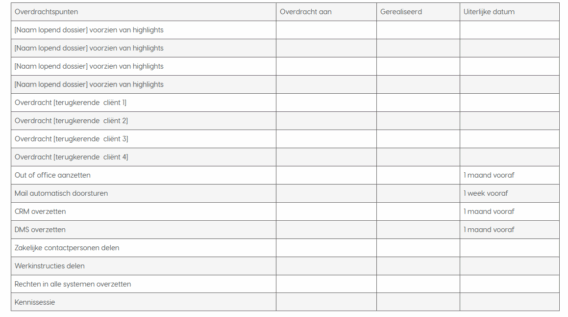
Work proactively to ensure smooth exits
Sooner or later, every company has to deal with employees who leave, whether voluntarily or not. To ensure a smooth handover of work, it’s wise to work and archive digitally as much as possible. This can be done in full compliance with the GDPR by, for example, using access rights or tags.
Through Digital Business Operations
It’s definitely time to remove the Rolodex from the desk. Make sure all clients, external partners, and other contacts your colleagues work with are stored digitally. This can be done in-house within a secure environment—for example, in a document management system (DMS) or a CRM that can be linked to this DMS. When the exit takes place, the rights are transferred. The contact persons have signed a data processing agreement for this purpose.
Centralized document management is also useful. By establishing a consistent approach to creating files, essential information is always accessible to colleagues. This prevents you from becoming overly dependent on a single employee, and the handover of tasks becomes simply a matter of adjusting permissions.
Another habit of
Make it a habit to share information within your company, even offline. For example, by encouraging colleagues to proactively share knowledge with one another. Have a different colleague give a presentation to the rest of the staff each month—on topics such as how to comply with the GDPR more effectively, working more efficiently, improving sales, using the new CRM system, or a noteworthy case.
Give yourself some space
From now on, start at the beginning. Include a clause in every contract specifying a notice period of several months. For example, allow for two or three months from the date of notice until the actual departure. A generous notice period gives you time to find a suitable replacement and set the transition in motion. Legally speaking, the notice period for a permanent contract can even be as long as six months!